How a persistent world built around 31 songs delivered something a 10-minute concert never could.
In my previous post, I argued that the linear virtual concert — the Travis Scott model — is a spectacular but ultimately limited format. It delivers spikes, not relationships. If you haven't read that piece, the short version is: the 40-foot avatar is great television, but games can offer artists something far more valuable than a stage. They can offer a home.
The Daft Punk Experience in Fortnite is the best proof of concept we have for what that home can look like. I was Lead Producer on Fortnite Festival at Epic Games, helping out on this project where I could, and served as the moderator on a talk about this experience at Amsterdam Dance Event 2025. So I've had the privilege of seeing it from the inside. What I want to do here is break down why it worked — not just as a marketing activation, but as something that genuinely moved people.
Most importantly, the credit for this incredible event goes to the teams at Epic, Magnopus, and Daft Punk working in incredibly tight collaboration to create a true moment in music gaming history.
It Wasn't a Concert
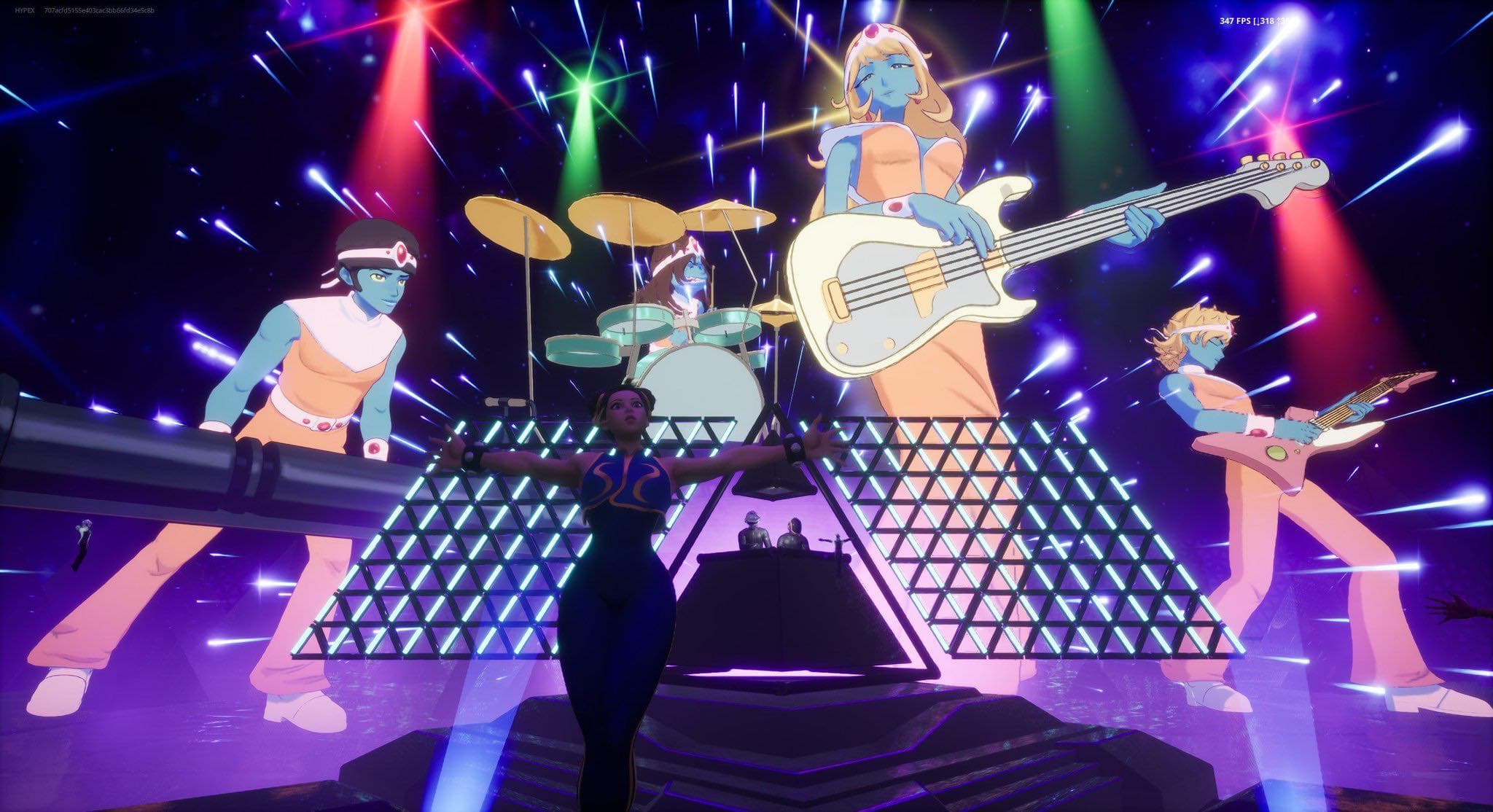
This is the most important thing to understand, and the thing that made all the difference. The Daft Punk Experience was not a concert. There was no linear setlist. No passive audience watching an avatar perform. Instead, it was a persistent, explorable world — a place you could visit, inhabit, and return to on your own terms.
The experience featured five distinct themed environments: the Dream Chamber Studios, where players could interact with remix tools; the Robot Rock Arena, built around rhythm-based gameplay; an Around the World LEGO Room that brought a playful physicality to the music; the Daft Club social and dance space; and the centerpiece Alive 2007 Arena, a faithful recreation of the stage design from one of the most legendary electronic music tours ever performed. Thirty-one songs from the Daft Punk catalog threaded through the entire experience, with dynamic visual effects shifting per track.
This wasn't something you watched for 10 minutes and talked about on Twitter. This was something you lived in. And that distinction matters enormously.
The Emotional Weight of Farewell
You can't talk about why the Daft Punk Experience resonated without talking about the emotional context. Daft Punk announced their breakup in February 2021 with "Epilogue," an eight-minute video of the two robots walking through a desert before one of them self-destructs. There was no farewell tour. No final show. Just an ending.
For a fanbase that had waited over a decade since the duo's last album, and who had built deep emotional connections to this music across their lifetimes, there was a profound sense of unfinished business. The Fortnite experience didn't try to simulate a reunion — Epic and Daft Punk were explicit that this was a tribute, not a comeback. But it gave fans something they didn't know they needed: a space to gather around the music one more time.
The fan response bore this out. NME reported fans calling it "absolutely incredible." Social media was flooded with players saying things along the lines of never expecting to thank Fortnite for providing emotional closure with a band they loved. Parents wrote about experiencing the music with their children — introducing a new generation to Discovery and Homework in a context that felt alive rather than archival. One sentiment I saw captured it perfectly: a father describing the experience as a memory with his son that they'd both carry forever.
That kind of emotional resonance doesn't come from spectacle. It comes from care.
Deep Integration, Not Bolt-On Marketing
What set the Daft Punk Experience apart from a production standpoint was how deeply it integrated with Fortnite's existing systems. This wasn't a walled-off promotional island disconnected from the rest of the game. It was designed to meet players where they already were, using mechanics and reward structures they already understood.
Six quests were available within the experience, granting XP and two exclusive cosmetic sprays. The premium cosmetic bundles featured Daft Punk's iconic GM08 and TB3 helmets as wearable outfits, available in both standard Fortnite and LEGO styles. Players who attended the live premiere within a specific window received exclusive Waveform Walkers kicks. A "Get Lucky" emote let players carry a piece of the experience into every other mode in the game.
This is a subtle but critical design philosophy: when you tie an artist experience to systems players are already invested in — XP progression, cosmetic collections, emotes they can use in Battle Royale or Creative — you create connective tissue between the artist and the player's ongoing life in the game. The Daft Punk helmets didn't disappear when the experience ended. They stayed in players' lockers, showing up in matches months later, sparking conversations, triggering memories. The music didn't live in a one-time event. It lived in the ecosystem.
For many players, this integration with Fortnite's quest system created their first Jam session, or their first reason to explore the LEGO mode, or their first purely music-focused experience in the game. The Daft Punk Experience didn't just serve existing players — it served as an onramp, pulling game fans into music systems in Fortnite they might never have engaged with otherwise.
The Long Tail
The premiere drew 1.5 million concurrent players — impressive, but the real story is what happened after. Unlike a linear concert that ends and vanishes, The Daft Punk Experience persisted. Players could return whenever they wanted, explore at their own pace, and discover details they'd missed on earlier visits.
Fan engagement was strong enough that Epic extended the experience well beyond its original November 1, 2025 quest deadline, keeping it live until March 19, 2026. That's nearly six months of continuous availability. The decision to eventually vault the experience generated its own wave of headlines and community engagement — fans organizing final visits, sharing screenshots, mourning the closure the way you'd mourn a favorite venue shutting its doors.
The streaming data tells a similar story of sustained interest rather than a single spike and decay. Daft Punk saw an increase in Spotify monthly listeners, a jump in Wikipedia page views, and a boost in YouTube views. But more importantly, these increases weren't just a spike and crash the way many post-concert bumps typically behave.
What This Means for What Comes Next
The Daft Punk Experience worked because it was built on a fundamentally different set of assumptions than the linear concert model. Instead of asking "how do we create the biggest possible moment?", the team asked "how do we create a space that honors this music and rewards exploration?" Instead of optimizing for peak concurrency, they optimized for emotional depth and replayability. Instead of building a stage, they built a world.
This doesn't mean the linear concert is dead — far from it. There will always be a place for the massive, synchronous, everyone-watching-together event. But the Daft Punk Experience proved that the alternative isn't just viable, it might actually be better at the thing artists care most about: building real, lasting connections with fans.
The next frontier isn't bigger avatars or more expensive particle effects. It's figuring out how to take the principles that made the Daft Punk Experience special — persistence, integration, emotional care, player agency — and apply them across the full spectrum of how music shows up in games. Not as interruptions to the game. As part of the game itself.
Daft Punk gave us the blueprint. Now it's on the rest of us to build on it.
JP Kellams is the founder of Synaesthesia, a consultancy focused on the convergence of gaming and music. Previously, he was Lead Producer on Fortnite Festival at Epic Games. He has spoken at GDC, CEDEC, and the Amsterdam Dance Event on topics ranging from team leadership to the future of live music in interactive spaces.